
Portugal and Spain are some of the most beautiful places in Europe to keep a horse: light, space, and an outdoor life that simply isn't possible in northern Europe nine months of the year. The fact that the same sun and dry summers also mean a pasture here works differently, nutritionally, than a pasture in Normandy isn't a shortcoming. It's just a different kind of landscape, with its own logic, and it's exactly why hay for horses plays such a central role in the diet here, not as a backup, but as the main event.
Quick answer: Horse grazing in Portugal and Spain is naturally more seasonal and less continuous than in wetter parts of Europe. Mediterranean pasture dries out for long stretches of the year, which is why horse hay quality matters more here than almost anywhere else in Europe.
Montado and Dehesa: The Ancient Grazing System Behind Iberian Pasture
One of the defining landscapes of inland Iberia is called montado in Portugal's Alentejo region, and dehesa across Extremadura and parts of Andalusia in Spain: scattered oak trees over open grassland, covering roughly 2 to 2.5 million hectares. It's one of the oldest and most deliberate farming systems in Europe, precisely matched to what this soil and climate can sustain: drought-resistant, low-intensity, and built to last for centuries without exhausting the land.
Research into this system shows that grass yield depends heavily on where rainwater collects in the landscape and how deep the soil runs before hitting bedrock. That's a structural feature of the terrain, the same way a river-clay polder or a French limestone plain has its own structural traits. It says something about the type of grass that grows here, not about the quality of the land or how it's managed.
Why Rainfall (or the Lack of It) Shapes the Soil
Mediterranean grasslands evolved on nutrient-poor soils, and summers here often go weeks without a drop of rain. Research into European grasslands confirms the pattern you'd notice yourself driving from Portugal to northern France: the highest grass productivity sits in humid, oceanic regions, the lowest in dry Mediterranean ones.
Long-term data shows that yields on dry pasture can drop by roughly 28% in dry years, independent of how much nutrition is actually in the soil. Water isn't just one factor, it's often the limiting one. A French pasture in Normandy or the Loire gets regular rain all year round. A pasture in southern Portugal or Spain, from the Algarve to Andalusia, gets most of its annual rainfall in a few winter months and almost nothing after that.
What This Means for the Hay Grown on the Same Ground
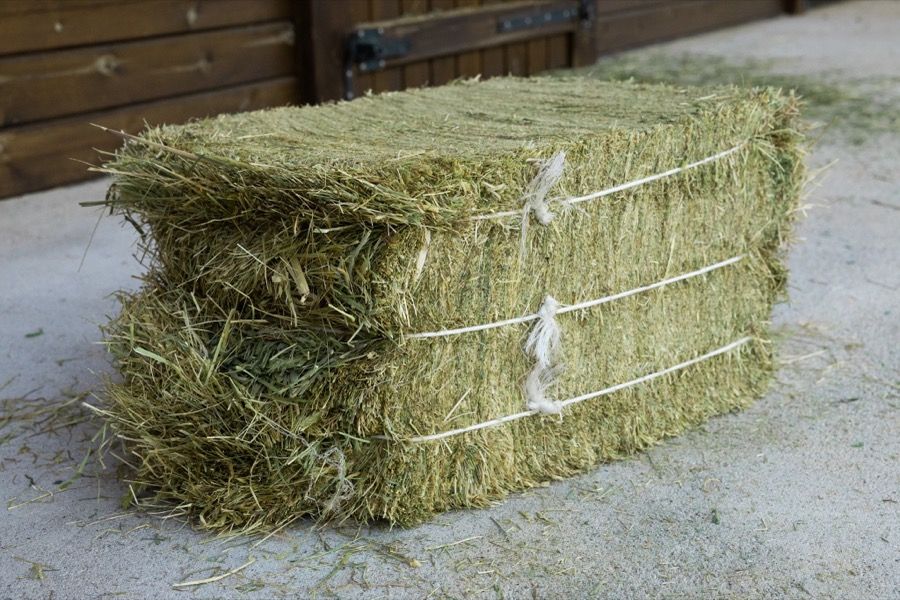
Hay is simply grass that's cut and dried at the point of peak nutritional value. If the grass itself grows on naturally dry, lean soil, the hay inherits those same traits. Climate research into Iberian pastures also shows that grass quality can come under further pressure as conditions get warmer and drier, even when total grass volume sometimes increases. More volume doesn't automatically mean more nutrition.
That's why two bales of hay that look identical can differ significantly in protein and energy values, purely depending on where and on what ground the grass grew, and it's why running your horse's numbers through our feeding calculator matters more here than it would somewhere with year-round grazing.
Why Prime Hay Also Sources From France
Prime Hay proudly sells locally grown hay from Portugal and Spain. We seek out the best batches ourselves and assess them carefully before they enter our range. What local hay finds harder to offer, simply because of the climate described above, is a consistent baseline that holds steady from batch to batch. One delivery can be excellent, the next slightly leaner, depending on the season and the plot it came from.
For customers where that consistency really matters, a sport horse, a broodmare, a sensitive stomach, we therefore also successfully source French meadow hay, alongside our local Spanish and Portuguese range. Ours comes from river-valley meadows such as the Val de Sarthe and Val de Meuse, land that floods gently each year and is left with fertile soil behind it, then a first cut, sun-dried in the field rather than cured indoors. These regions get steady rainfall through the growing season instead of Iberia's long dry stretch, so the grass simply doesn't face the same water stress, which is what gives the hay its more consistent baseline, batch after batch. We buy it through a specialist forage house in the south of France that has traded hay since 1988 and works with around 300 French farms, so what reaches you isn't one farmer's one field, it's a consistently selected first cut across multiple regions like these.
That means you can choose what fits your horse: the best of local ground, or the predictability of French hay, and we search and assess carefully on both sides so you never have to gamble. For more on how we select our hay, see the science behind our hay.
Sources
- Montado Mediterranean Ecosystem (Soil–Pasture–Tree and Animals): A Review of Monitoring Technologies and Grazing Systems — https://www.mdpi.com/2076-3417/13/10/6242
- Small scale soil variation and its effect on pasture yield in southern Portugal — https://www.sciencedirect.com/science/article/abs/pii/S0016706112004181
- Unravelling the contribution of soil, climate and management to the productivity of ecologically intensified Mediterranean wood pastures — https://www.sciencedirect.com/science/article/abs/pii/S0048969724077325
- Implications of accounting for management intensity on carbon and nitrogen balances of European grasslands (PLOS One) — https://journals.plos.org/plosone/article?id=10.1371%2Fjournal.pone.0201058
- Climate change alters pasture productivity and quality in Mediterranean silvopastoral ecosystems — https://www.sciencedirect.com/science/article/abs/pii/S0167880923003626