
If you've been asking around for hay lately and getting shrugs, longer waiting times or a higher price, you're not imagining it. In Portugal the spring and early summer were very dry; in Spain a reasonable spring was followed by a record hot, dry summer. The good news: with early planning, you can keep your horse's forage supply more consistent through autumn and winter.
Quick answer: Local hay supply is tighter in places this autumn, prices are rising and quality varies more from load to load. Plan your stock until spring, check every new load, store it dry and switch gradually over 7 to 10 days.
Key takeaways
- Portugal: five dry to extremely dry months in a row (IPMA). Spain: the hottest summer since at least 1869 (AEMET).
- Northern Spain: hay harvests down by up to 40% in some areas, straw around 27% more expensive (Campo Galego).
- A 500 kg horse needs roughly 55 to 70 small bales from mid-October to the end of March.
Questions about your own horses? WhatsApp us, we answer in English, Português and Español.
What happened to the 2026 growing season?
The winter of 2025/26 was wet, but most of that rain fell in a few months. After that, the two countries went different ways:
- Portugal: five dry to extremely dry months in a row before a wetter August (IPMA via Tempo.pt), then the hottest September since records began in 1931, 2.9°C above normal (IPMA).
- Spain: after a reasonable spring in many regions, the hottest summer since at least 1869, with 56% of normal summer rainfall (AEMET).
What the weather does, and doesn't, tell us
Weather data alone doesn't prove a hay shortage everywhere. Hay supply also depends on irrigation, soil, the timing of the cut and last year's stocks, and Spain's record 2025 harvest left good reserves in many places. What we can say:
- Northern Spain: after favourable spring rain, drought and heat followed; hay harvests are reported down by up to 40% in some mountain areas, and straw around 27% more expensive in two months (Campo Galego).
- Portugal: there are no official figures on hay stocks yet. A dry spring usually means a lighter first cut in rain-fed fields, and where fields aren't irrigated, regrowth for a second cut depends on summer rain, which largely failed this year.
- Pastures dried out early, so many owners started feeding hay sooner.
None of this is about the skill of the farmers: they have done a remarkable job in a very hard year, and we work with local growers ourselves.
Local or imported hay? Judge the batch, not the country
Origin alone doesn't prove quality. Portuguese and Spanish hay has real strengths: grown close to home, short transport, and in a good season it can be excellent. Because our grass grows on dry soils with most of the rain in winter, it does depend more on the weather of that one year (more in The Ancient, 2.5-Million-Hectare Secret Behind Your Horse's Pasture).
Heat adds a second effect. In hot weather, grass tends to mature faster: more stem, less leaf, and leaf is where much of the nutrition sits. So two bales that look the same can still differ in protein, energy and fibre. That's why we judge every batch on its own, local or French. Our guide on how to read a hay lab analysis explains every number.
How much hay should you plan for?
As a rough guide, a horse needs forage of at least 1.5% of its body weight per day in dry matter; in practice that's about 8 to 10 kg of hay a day for a 500 kg horse. From mid-October to the end of March is roughly 165 days:
- Per 500 kg horse: about 1,300 to 1,650 kg of hay, or roughly 55 to 70 small bales of about 24 kg.
- Add a buffer of around 10% for waste, a cold spell or a late spring.
- Adjust for ponies, easy keepers, hard work and remaining grazing (see how much hay does your horse need).
Securing that volume early protects you from gaps and later price rises. One or a few horses? Put a pallet together with the Pallet Builder. A bigger yard? Request a full-truck quote.
How to judge the quality of a new load
In a difficult year it pays to look more closely at every load, whoever you buy from:
- Smell: fresh and sweet. A musty, sour or dusty smell is a warning sign.
- Mould and heat: open a few bales. No white or grey patches, no clumps, and the inside should not feel warm.
- Dust: shake a flake. A cloud of fine dust is bad news for your horse's airways.
- Leaf and structure: plenty of leaf and soft stems are a good sign; very coarse, brittle stems usually mean a late cut.
- Colour: green to light gold is normal. Colour says something about drying and storage, but not about sugar; only a lab analysis tells you that.
- Clean: no weeds, soil, plastic or other foreign material.
Store it dry
- Keep bales off the ground on pallets, so moisture can't rise into the bottom layer.
- Keep them under a roof and protected from driving rain, but with airflow, so moisture can escape.
- Use first in, first out, and check fresh stacks for warmth in the first weeks.
- Keep hay away from fuel, machinery and anything that can spark.
Switch gradually to a new batch
Every batch is slightly different and your horse's gut needs time to adapt. Mix old and new over 7 to 10 days, for example 25% new for the first three days, then 50%, then 75%, then 100%. Keep a few bales of the old hay back so you can do this, and take extra care with horses prone to colic, ulcers or laminitis.
Got a sensitive horse? For horses prone to laminitis, EMS or ulcers, a steady, low-sugar hay as the base of the diet is one of the best things you can give. Fresh autumn regrowth after a drought can be surprisingly rich in sugar, so limit turnout on it (a grazing muzzle helps) and keep hay available. Our French meadow hay typically comes in around 4.5% sugar. Not sure if it suits your horse? WhatsApp us and we'll tell you honestly, and always check with your vet.
How Prime Hay keeps French hay reliable
2026 was a dry year in much of Europe, France included, so origin alone is no guarantee. What matters is how a batch is bought, selected and checked.
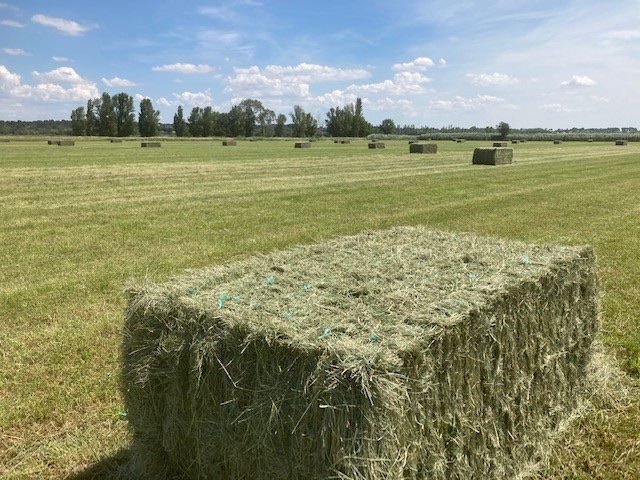
First-cut French meadow hay bales awaiting collection. Photo: our French supplier.
- We buy in large volumes. We secure French meadow hay by the truckload and commit early, which keeps supply steady for our customers when the market gets tight.
- One trusted supplier. We buy through a specialist forage house in the south of France that, by its own account, has traded hay since 1988 and works with around 300 French growers, selecting first cut across several river-valley regions.
- Quality control. We use independent lab analyses when selecting our forages, and our team checks the hay again at our depots before it goes out.
Typical values for our French meadow hay are 4.5% sugar and 8.1% protein on dry matter: a calm, high-fibre hay that suits most horses, including many that need to watch their sugar intake.
Running a yard, stud or riding school?
For stables with 10 or more horses we deliver full trucks of French hay straight to your yard: around 26 tonnes of small bales or 18.5 tonnes of big bales. Request a full-truck quote and we reply personally with a delivered quote for your region. It's the easiest way to secure your season's hay in one go.
Prefer a written quote? Email us at hello@primehayinternational.com with your location and number of horses, and we'll send you a quote by email.
Buying hay in Portugal and Spain with Prime Hay
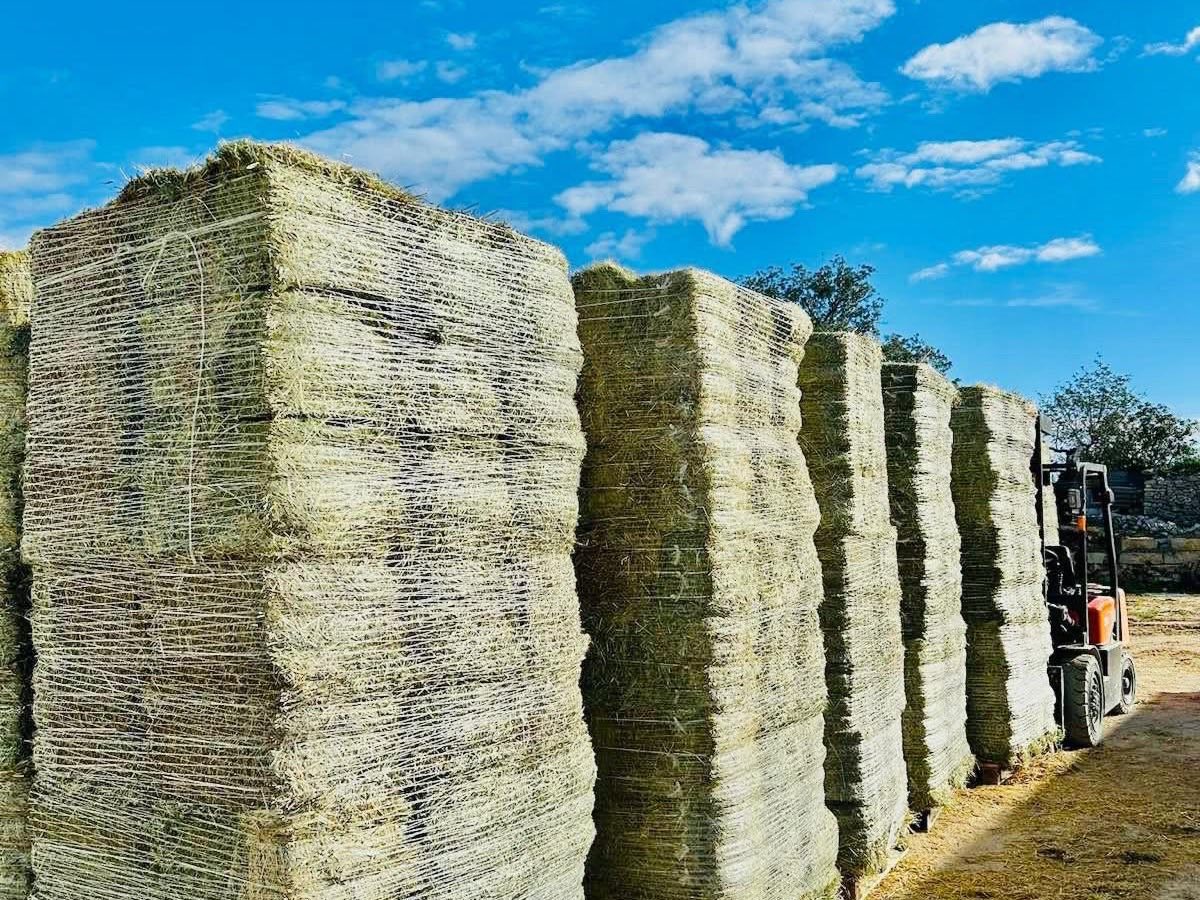
Hay on pallets at our depot, ready for delivery across Portugal and Spain.
We sell selected local hay, French meadow hay and alfalfa. With depots in the Algarve (Loulé) and the Ribatejo (Almeirim), the Prime Hay team or a trusted transport partner delivers across Portugal and Spain. More than 600 stables have ordered from us, from the Algarve and Alentejo to Lisbon, Cascais and the Ribatejo, and across the border in Andalusia and Extremadura.
You'll find all current prices in our shop, and for full loads you can request a full-truck quote and we reply personally with a delivered quote. Not sure whether local or French hay suits your horse, or how much to order? Send us a WhatsApp. We'd rather help you order the right amount than the biggest one.
Frequently asked questions
Is there a hay shortage in Portugal and Spain in 2026?
Supply is tighter in places: northern Spain reports smaller harvests and higher prices, while Portugal has no official figures yet. Hay is still available, and planning ahead is wise.
Will hay prices go up in Portugal and Spain this winter?
When supply is lower and demand starts earlier, prices usually rise as the season goes on. Straw in northern Spain, for example, rose around 27% in two months this summer. Securing your season's hay early is the simplest way to avoid rising prices.
Is French hay always better than local hay?
No. Origin alone doesn't prove quality; every batch should be judged on its own. Local hay can be excellent, it just depends more on the weather of that year. We sell both and select each batch ourselves.
Where can I buy good horse hay in Portugal and Spain?
Prime Hay delivers carefully selected local hay and selected French meadow hay across Portugal and Spain from depots in Loulé (Algarve) and Almeirim (Ribatejo). Order online or ask us on WhatsApp.
Sources
- IPMA, Climate bulletin September 2026 (Portugal)
- Tempo.pt / IPMA, August 2026 after five dry months in Portugal
- AEMET, Summer 2026 summary (Spain)
- Campo Galego, Drought and heat alter the forage market in northern Spain
- Penn State Extension, Managing Horse Pasture During and After a Drought
- National Research Council (2007), Nutrient Requirements of Horses